1. Head-to-head at a glance
| CodeOtter | Greptile | |
|---|---|---|
| Deployment | Self-hosted (Docker / Node) | Hosted SaaS — Enterprise-only self-host |
| Code leaves your infra | ❌ Never | ✅ Required (except Enterprise self-host) |
| Repository code-graph Q&A | ⚠️ Per-PR scope only | ✅ Full-repo natural-language Q&A |
| Scoring engine | Deterministic System 1 — 6 calibrated 0–100 gauges, 8 binary gates | LLM-only — chat model returns prose + summary |
| Score hallucination | ✅ Eliminated (rubric output) | ⚠️ Same problem as CodeRabbit |
| Pre-merge gates | 8 typed binary gates | ⚠️ Heuristic status checks |
| Offline mode | ✅ First-class — llama.cpp + GGUF | ❌ Self-host requires talking to sales |
AGENTS.md / CLAUDE.md auto-enforcement | ✅ Auto-detect + inject | ⚠️ .greptile/config.yaml only |
| 1-click "Dismiss & remember rule" | ✅ Persistent team learnings injected automatically | ❌ Not available |
Inline suggestion blocks | ✅ Committable on GitHub | ✅ Committable on GitHub |
| Incremental delta review | ✅ prevSha → headSha per commit | ⚠️ Re-indexes on push |
| PR comment upsert | ✅ <!-- codeotter:scores --> markers | ⚠️ New comment per run |
| Architecture / Blast Radius diagram | ✅ Interactive offline SVG Mermaid | ❌ |
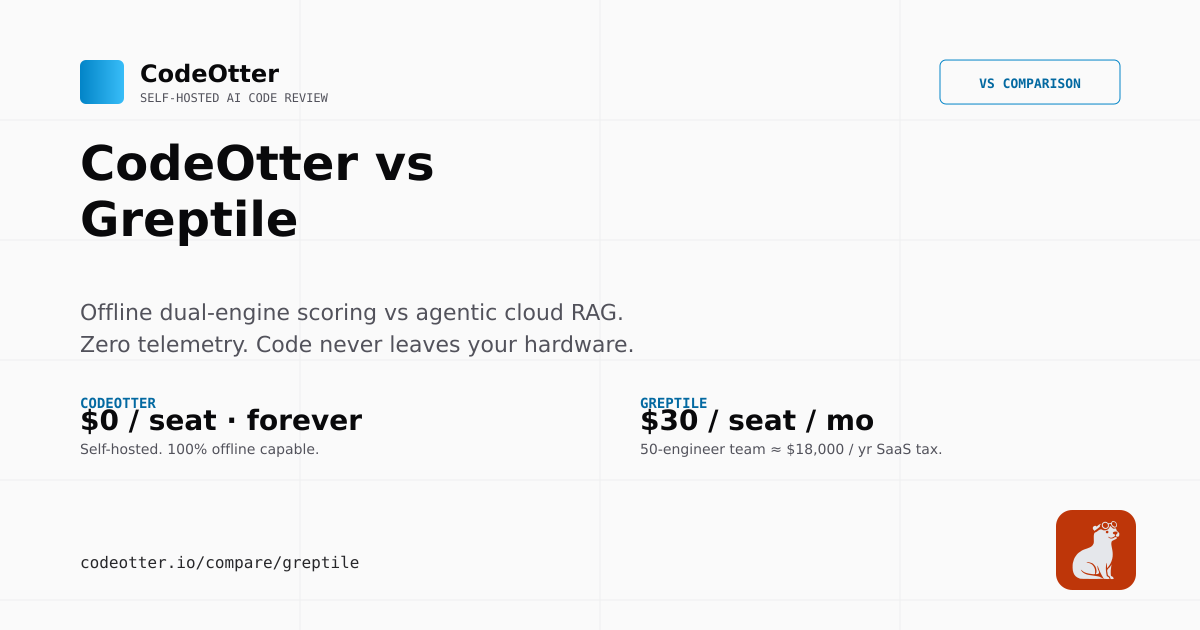
| Pricing model | Free, self-hosted | $30/dev/mo + Enterprise (sales call) |
| Open source | ✅ AGPL-3.0 | ❌ |
2. Architectural differences that actually matter
2.1 Repo-graph Q&A: Greptile's core differentiator
Greptile's standout feature is full-repo natural-language Q&A. You can ask:
"Where do we construct JWTs in the auth path? Show me the relevant code and which PRs introduced it."
Greptile answers with real file paths and PR citations because it indexes your entire repo as a graph. This is genuinely useful for monorepo archaeology.
CodeOtter's scope is per-PR: it reviews the diff against the repo's AGENTS.md / CLAUDE.md rules and produces scores + findings + cohort walkthroughs. It does not maintain a long-lived searchable index for Q&A.
Honest takeaway: if "ask the codebase a question in Slack" is a daily workflow, Greptile wins on that feature. If you only need PR review and team-rule enforcement, CodeOtter wins.
2.2 Self-host posture
Greptile launched a v3.07 self-hostable variant in 2025 — but:
- It's gated behind Enterprise pricing (sales call required).
- You still pay per-seat — self-host is just a deployment model.
- The model weights are proprietary and shipped as a black box.
CodeOtter is self-host-first by design:
- The repository is open source under AGPL-3.0.
- Models are open-weight (Qwen, DeepSeek, Llama, MiniMax) or your BYOK Claude/OpenAI key.
- There is no per-seat price. There is no sales call. There is no "Enterprise" tier. It is free to self-host under AGPL-3.0, with zero per-seat billing.
2.3 The dual-engine split (CodeOtter) vs the unified LLM (Greptile)

View Mermaid source
flowchart LR
  PR["GitHub PR Diff + AGENTS.md / CLAUDE.md"] --> Facts["Deterministic Blast Radius\nFiles · Lines · Areas · Hotspots"]
  PR --> LLM["Engine 1: System 2 LLM\nWalkthrough · Cohorts · Findings"]
  PR --> S1["Engine 2: System 1 Engine\n6 Calibrated Scores + 8 Gates"]
  Facts --> Report["Unified Review Report"]
  LLM --> Report
  S1 --> Report
CodeOtter's System 1 engine (POST /v1/systemone) returns rubric-defensible scores you can diff between PRs. Greptile's scores come from a chat model asked to summarize. Same hallucination problem as every other SaaS reviewer in this space.
3. Pricing & TCO — 50-engineer team, 3-year horizon
Anchored to Greptile's published pricing and the Greptile v3 blog. Assumes 50 active devs, USD list price, no annual prepay discount.
| Tier | CodeOtter | Greptile Team | Greptile Enterprise (self-host) |
|---|---|---|---|
| Per-seat / month | $0 | $30 | Sales call — typically $50–$80 |
| Monthly cost (50 devs) | $0 | $1,500 | $2,500–$4,000 |
| Year-1 total | $0 + ~$200/yr VPS | $18,000 | $30,000–$48,000 |
| 3-year total | ~$600 | $54,000 | $90,000–$144,000 |
| Cost per PR reviewed | $0 | ~$0.50 | $0.85–$1.30 |
CodeOtter 3-year TCO: ~$600. Greptile Enterprise 3-year TCO: $90K–$144K. That's a 150× to 240× difference.
For a 50-engineer team, switching from Greptile Enterprise to CodeOtter self-hosted saves $89K–$143K over 3 years — enough to fund a senior platform engineer.
4. Privacy & data flow
Greptile is hosted-only by default (Enterprise self-host is gated). Every diff is shipped to Greptile's cloud for indexing. They retain data to "improve the model" unless you negotiate otherwise.
CodeOtter is zero-telemetry by construction:
- No outbound HTTP except to your local model sidecar or your BYOK endpoint.
- Logs in your infra.
- Self-host = your compliance boundary.
If you're in fintech, healthtech, defense, or any shop where the CISO has ever vetoed a SaaS — CodeOtter is the only option in this comparison.
5. Where Greptile still wins (honest section)
| Capability | Why Greptile wins today |
|---|---|
| Full-repo Q&A | "Where do we construct JWTs?" — Greptile's repo-graph Q&A is genuinely differentiated. CodeOtter is per-PR scope. |
| Repo-wide indexing | Greptile builds and maintains a code graph across all branches. CodeOtter does not. |
| Sales & support motion | Greptile has named CSMs at Enterprise. CodeOtter is community + GitHub Issues. |
| Self-host roadmap | Greptile's self-host story is improving (v3.07+); still gated and per-seat priced. |
6. When CodeOtter is the obvious pick
Pick CodeOtter if any of these are true:
- You don't need repo-graph Q&A — most teams don't.
- Regulated industry — code cannot leave your VPC.
- Cost-sensitive scale — 50+ engineers and per-seat SaaS is a board conversation.
- Air-gapped or VPC-only infra — you already operate your own dev tooling.
- Score integrity matters — you want rubric-defensible gauges, not chat-model guesses.
- Team conventions are code — you maintain
AGENTS.md/CLAUDE.mdand want them enforced. - You already pay for GPU time — run a quantized GGUF model for free on hardware you're already amortizing.
7. Migration path from Greptile → CodeOtter
- Hour 0–1: Stand up CodeOtter via
docker run codeotter/codeotter. - Hour 1–2: Onboard your top repos. Copy
AGENTS.md/CLAUDE.mdfrom your Greptile knowledge base into the repo root. - Hour 2–3: Wire GitHub webhook for
pull_requestevents. - Hour 3–4: Disable Greptile per-repo. Enable CodeOtter.
- Day 2+: Cancel Greptile. Savings: $18,000–$48,000/year for a 50-engineer org.
What you lose: full-repo Q&A. What you gain: calibrated scores, zero SaaS tax, full data sovereignty.
8. FAQ
Is CodeOtter a drop-in replacement for Greptile?
For review behavior, mostly yes. For full-repo Q&A, no — CodeOtter is per-PR scope by design. If your team relies on Greptile's "ask the codebase" workflow daily, plan a transition.
Can I run both?
Yes. Greptile's GitHub App and CodeOtter's webhook can coexist on the same repo. Many teams run Greptile for Q&A and CodeOtter for PR review + gates.
Does CodeOtter's System 1 engine actually beat Greptile's scores?
On calibration, yes. Greptile's summary score comes from a chat model. CodeOtter's gauges are deterministic rubric outputs that span 0–100 — you can defend Quality: 42 in a postmortem because the rubric says why.
What about model auditability?
Greptile uses proprietary models you can't inspect. CodeOtter runs on any open-weight GGUF (Qwen2.5-Coder, DeepSeek-Coder, Llama 3.x, MiniMax-M3) or your BYOK key. You pick the model; you audit the weights.
9. Sources
CodeOtter (primary)
- CodeOtter README
- CodeOtter ROADMAP (2026-09-29)
- CodeOtter CHANGELOG v0.2.0 (2026-09-29)
- CodeOtter
POST /v1/systemonedocs