1. Head-to-head at a glance
| CodeOtter | CodeRabbit | |
|---|---|---|
| Deployment | Self-hosted (Docker or Node) — your hardware | Hosted SaaS (default); Enterprise offers self-host in your own infrastructure |
| Code leaves your infra | ❌ Never | ✅ Every PR diff |
| Telemetry | Zero — zero outbound calls | Yes — product analytics + model telemetry |
| Scoring engine | Deterministic System 1 (POST /v1/systemone) — 6 calibrated 0–100 gauges, 8 binary gates | LLM-only — chat model returns prose + rough number |
| Score hallucination | ✅ Eliminated — gauges are deterministic rubric outputs | ❌ Yes — chat models cluster scores 75–85 |
| Pre-merge gates | 8 typed binary gates (Title, Description, Security, Complexity, Tests, Docs, Scope, Guidelines) + 1 issue-link gate | ⚠️ Heuristic status check only |
| Offline mode | ✅ First-class — llama.cpp + ggmlc + auto Vulkan/Metal | ⚠️ Hosted by default; Enterprise self-host available |
AGENTS.md / CLAUDE.md auto-enforcement | ✅ Auto-detect + inject into every review prompt | ⚠️ .coderabbit.yaml only (no team-learning carry-over) |
| 1-click "Dismiss & remember rule" | ✅ Persistent team learnings injected automatically | ❌ Not available |
Inline suggestion blocks | ✅ POST /api/review-suggestions → committable on GitHub | ✅ Committable suggestions |
| Incremental delta review | ✅ prevSha → headSha per commit | ⚠️ Re-reviews the full PR |
| PR comment upsert | ✅ <!-- codeotter:scores --> markers — updates in-place | ❌ New comment each run (no upsert) |
| Architecture / Blast Radius diagram | ✅ Interactive offline SVG Mermaid | ❌ |
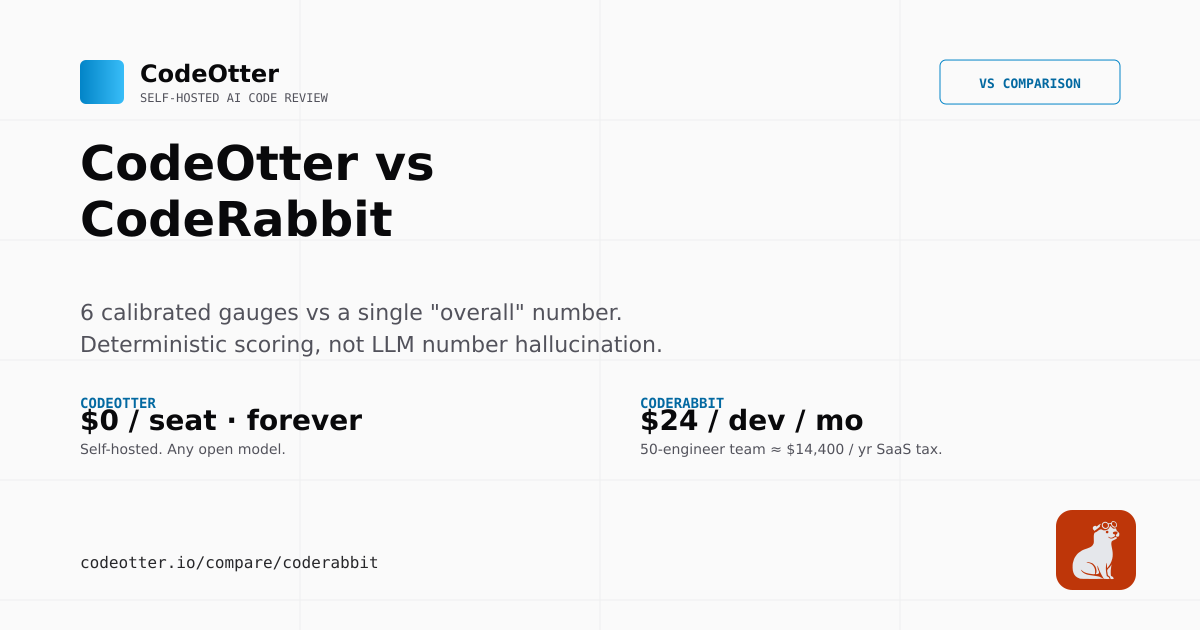
| Pricing model | Free, self-hosted ($0/seat forever) | $24/dev/mo (Pro) — $43,200/yr for 50 devs |
| Enterprise tier | N/A (you operate it) | $30–$72/dev/mo with SSO/SOC 2/BAA |
| Open source | ✅ AGPL-3.0 | ❌ |
2. Architectural differences that actually matter
2.1 The dual-engine split
CodeOtter splits review into two specialized engines that run concurrently:

View Mermaid source
flowchart LR
  PR["GitHub PR Diff + AGENTS.md / CLAUDE.md"] --> Facts["Deterministic Blast Radius\nFiles · Lines · Areas · Hotspots"]
  PR --> LLM["Engine 1: System 2 LLM\nWalkthrough · Cohorts · Findings"]
  PR --> S1["Engine 2: System 1 Engine\n6 Calibrated Scores + 8 Gates"]
  Facts --> Report["Unified Review Report"]
  LLM --> Report
  S1 --> Report
CodeRabbit's review is a single chat LLM that produces prose + a numeric "summary score." That's why scores feel soft: the prompt asks for a number, the model returns ~85, and there's no rubric signature you can audit. CodeOtter's POST /v1/systemone produces gauge definitions + raw rubric inputs that you can diff between PRs — Quality: 78 (up from 71) because we added 14 tests is a real claim, not vibes.
2.2 Where the code lives
| CodeOtter | CodeRabbit | |
|---|---|---|
| Diff sent to vendor cloud | ❌ Never | ✅ Every PR |
| Model weights in your infra | ✅ Optional (GGUF + llama.cpp) | ❌ Vendor-side |
| Logs in your control | ✅ Local | ⚠️ Vendor |
| GDPR / HIPAA / FedRAMP path | ✅ Self-host = your compliance | ⚠️ Requires Enterprise + BAA |
If "our code never leaves our VPC" is a regulatory requirement, CodeOtter is the only option. CodeRabbit Enterprise offers BAA/SOC 2 but still exfiltrates diffs.
2.3 Team-rule enforcement
CodeOtter detects AGENTS.md and CLAUDE.md at every repo root on every PR and injects those rules into both the System 1 and System 2 prompts. If a reviewer hits a finding that's a known team preference, a single click "Dismiss & remember rule" persists the rule into Settings → Repositories → ⚙️ and it is auto-injected into every future review.
CodeRabbit's .coderabbit.yaml is a static config file — there's no per-finding learning loop. You can teach the model repo conventions; you can't say "stop flagging this, we know."
3. Pricing & TCO — 50-engineer team, 3-year horizon
Anchored to CodeRabbit public pricing and the Augment 2026 teardown. Assumes 50 active devs, USD list price, no annual prepay discount.
| Tier | CodeOtter | CodeRabbit Pro | CodeRabbit Enterprise |
|---|---|---|---|
| Per-seat / month | $0 | $24 | $30–$72 |
| Monthly cost (50 devs) | $0 | $1,200 | $1,500–$3,600 |
| Year-1 total | $0 + ~$200/yr (a cheap VPS) | $14,400 | $18,000–$43,200 |
| 3-year total | ~$600 (your VPS) | $43,200 | $54,000–$129,600 |
| Cost per PR reviewed | $0 | ~$0.40 | $0.50–$1.20 |
CodeOtter 3-year TCO: ~$600. CodeRabbit Pro 3-year TCO: $43,200. That's a 72× difference.
The CodeOtter line item is a small VPS (4 vCPU / 8 GB RAM is plenty for a 50-engineer team — most System 1 work runs on a quantized 0.8B–1.5B GGUF). If you already have a developer Kubernetes cluster or a CI runner pool, the marginal cost is $0.
4. Privacy & data flow — non-negotiable for regulated teams
CodeOtter's privacy posture is "zero telemetry by construction":
- No outbound HTTP from the review engine except to your local model sidecar (
llama-server) or your BYOK endpoint of choice. - No product analytics, no model telemetry, no "is this working?" callbacks.
- Logs live in your infra.
- Self-host = you inherit your own SOC 2 / HIPAA / FedRAMP boundary.
CodeRabbit's data flow:
- Every PR diff is shipped to CodeRabbit's cloud for review.
- CodeRabbit retains diffs to "improve the model" (per their privacy docs) unless you are on Enterprise with a BAA.
- CodeRabbit product analytics tracks dashboard sessions.
- They are SOC 2 Type II and offer BAA at Enterprise, but the diffs still traverse their infra.
If you're in fintech, healthtech, defense, or any shop that has ever had a CISO say "absolutely not" to a new SaaS — CodeOtter is the only option in this comparison.
5. Where CodeRabbit still wins (honest section)
| Capability | Why CodeRabbit still wins today |
|---|---|
| Time to first review | Click "install GitHub App," 60 seconds. CodeOtter needs a Docker deploy (5–15 minutes). |
| IDE integrations | CodeRabbit ships a VS Code extension; CodeOtter is web/dashboard only. |
| Slack/Linear/Jira hooks | CodeRabbit has first-class SaaS integrations out of the box. CodeOtter is webhook-driven — easy to wire, but DIY. |
| Adoption polish | CodeRabbit's dashboard is more "marketing-ready." CodeOtter's dashboard is functional and honest — fewer animations, more substance. |
| Managed multi-tenant org admin | CodeRabbit has a polished org admin. CodeOtter's admin is per-instance — fine for one team, more work for an MSP. |
If you want "install, integrate, and forget," CodeRabbit's SaaS ergonomics beat CodeOtter today. If you want "calibrated, self-hosted, $0 forever, and stops hallucinating scores", CodeOtter wins.
6. When CodeOtter is the obvious pick
Pick CodeOtter if any of these are true:
- Regulated industry — you cannot send diffs to a third party.
- Cost-sensitive scale — 50+ engineers and per-seat SaaS is a board-level conversation.
- Air-gapped or VPC-only infra — you already operate your own dev tooling.
- Score integrity matters — you want rubric-defensible gauges, not chat-model guesses.
- Team conventions are code — you maintain
AGENTS.md/CLAUDE.mdand want them enforced at the merge gate. - You already pay for GPU time — you can run a quantized GGUF model for free on hardware you're already amortizing.
7. Migration path from CodeRabbit → CodeOtter (1-day cutover)
- Hour 0–1: Stand up CodeOtter via
docker run codeotter/codeotter(orpnpm starton Node 20.11+). - Hour 1–2: Onboard your top repos. CodeOtter reads
AGENTS.md/CLAUDE.mdautomatically — copy them in. - Hour 2–3: Wire GitHub webhook for
pull_requestevents (one YAML manifest). - Hour 3–4: Disable the CodeRabbit GitHub App per-repo. Enable CodeOtter on the same repos.
- Day 2+: Cancel CodeRabbit. Savings: $14,400–$43,200/year for a 50-engineer org.
You keep every comment CodeRabbit ever made (GitHub history). You lose nothing.
8. FAQ
Is CodeOtter a drop-in replacement for CodeRabbit?
For review behavior, yes. For SaaS integrations (Slack/Linear/Jira auto-posting, IDE plugin), no — CodeOtter is webhook-driven and you wire those up yourself.
Will my reviewers miss CodeRabbit's polish?
Honestly: probably some will, for a week. CodeOtter's dashboard is functional and honest — fewer animations, more substance. Reviewers who care about calibrated scores and offline mode will not miss CodeRabbit.
Can I run both side-by-side during evaluation?
Yes. CodeOtter reads AGENTS.md and CodeRabbit reads .coderabbit.yaml — no conflict. Disable CodeRabbit repo-by-repo when you're confident.
Does CodeOtter's System 1 engine actually beat CodeRabbit's scores?
Yes, on calibration. CodeRabbit scores cluster between 75–85 because they come from a chat model asked to "give a number." CodeOtter's gauges are deterministic rubric outputs that span 0–100 — you can defend a Quality: 42 in a postmortem because the rubric says why.
What about the model itself?
CodeRabbit uses proprietary models you can't audit. CodeOtter runs on any open-weight GGUF (Qwen2.5-Coder, DeepSeek-Coder, Llama 3.x, MiniMax-M3, etc.) or your BYOK Claude/OpenAI/MiniMax/OpenRouter key. You pick the model; you audit the weights.
9. Sources
CodeOtter (primary)
- CodeOtter README
- CodeOtter ROADMAP (2026-09-29)
- CodeOtter CHANGELOG v0.2.0 (2026-09-29)
- CodeOtter
POST /v1/systemonedocs